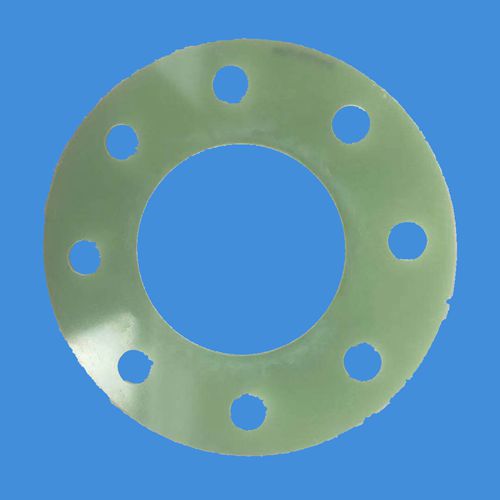

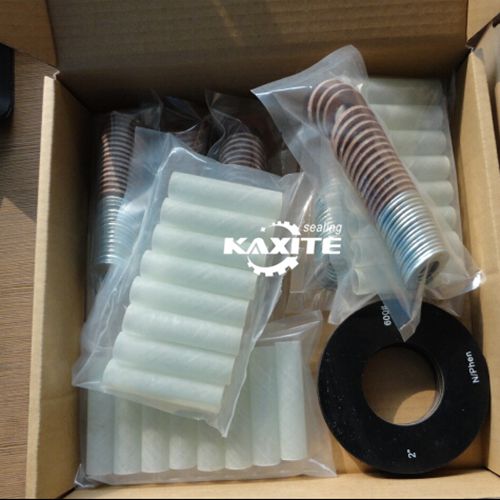
The KXT 1002 is not a different gasket geometry. It is a Type E full-face kit — same outside diameter as the flange, same precision-cut bolt holes, same coverage of the entire flange face. It is built for cathodic protection isolation on ASME B16.5 flanges. What changes is the material cross-section. A laminated phenolic core is sandwiched between two factory-bonded neoprene faces. The phenolic core does the electrical work. The neoprene faces do the sealing work — they compress into surface imperfections that a rigid plain phenolic gasket would sit on top of, not into.
Plain phenolic is a hard, rigid gasket. It seals by developing high contact stress against a flat, well-machined flange face. On a rough flange surface, pitted flange face or slightly warped flange, the contact stress is uneven and leakage paths can remain open. This is where a soft sealing flange insulation gasket has a practical advantage over rigid phenolic: the soft neoprene layer deforms into the surface profile at much lower bolt load, closing those paths before the phenolic core carries the compressive load. The practical difference is tolerance — neoprene faced kits are more forgiving of flange condition, at the cost of a lower temperature ceiling. For a rigid plain phenolic kit where the flange is in good condition and temperature is higher, see Type E plain phenolic insulation kits.
| Material | Sealing behaviour | Max Temp | Best for | Avoid when |
|---|---|---|---|---|
| Neoprene Faced Phenolic (this page) | Soft face; conforms to rough / slightly pitted flange surfaces | ~+80°C (Kaxite spec) | Standard oil & gas flanges, imperfect surface condition, sealing tolerance priority | Service above 80°C |
| Plain Phenolic (Type E default) | Rigid contact; relies on flat, well-machined flange face | +104°C | Well-machined flanges, higher temperature service | Rough or pitted flange faces |
| G10 / G11 Epoxy Glass | Rigid, higher strength | +138°C / +176°C | High temperature, high bolt load, strict electrical performance | Cost-sensitive standard service |
Temperature note: Kaxite specifies approximately +80°C for the KXT 1002 neoprene faced phenolic kit. Third-party industry references for neoprene-faced phenolic range from +79°C to +100°C depending on formulation and test method. Do not treat this material as a high-temperature substitute for plain phenolic or G10/G11. If the service temperature approaches the upper limit, confirm with the engineering team before ordering. For higher-temperature full-face isolation, see G10 insulation sleeves as part of a G10 carrier kit configuration.
| Dielectric strength | 500 V/mil |
|---|---|
| Compressive strength | 25,000 psi |
| Water absorption | 1.6% |
| Insulation resistance | 40,000 Meg Ohms |
| Flexural strength | 22,500 psi |
| Operating temperature | −54°C to approximately +80°C (Kaxite spec); industry references for this material class range up to +100°C |
| Pressure reference | ASME Class 300 / PN40 (~50 bar) industry reference; kit dimensions to ASME B16.5 flange standard |
| Standard thickness | 1/8″ (3.2 mm) |
| Geometry | Type E full-face; same OD as flange; precision-cut bolt holes |
For raised-face flanges where a ring gasket without bolt holes is required, see Type F Drop-in insulation kits. For RTJ ring grooves, see Type D RTJ insulation kits.
The installation procedure is the Type E procedure. Insert the insulating sleeves into the bolt holes, locate the gasket on the sleeves, close the flange, and torque in a star pattern (30% → 60% → 100% of recommended torque). Wrap the flange OD with insulation tape after bolting as a secondary barrier against conductive debris. The neoprene faces do not change the installation sequence — they change the surface tolerance during service.
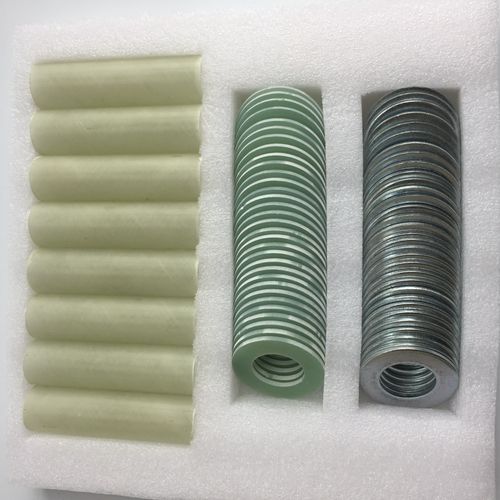
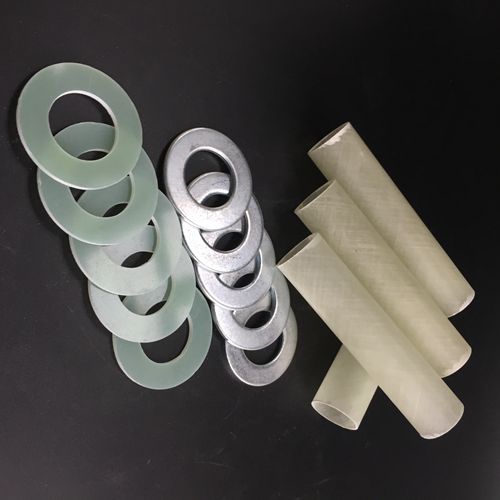
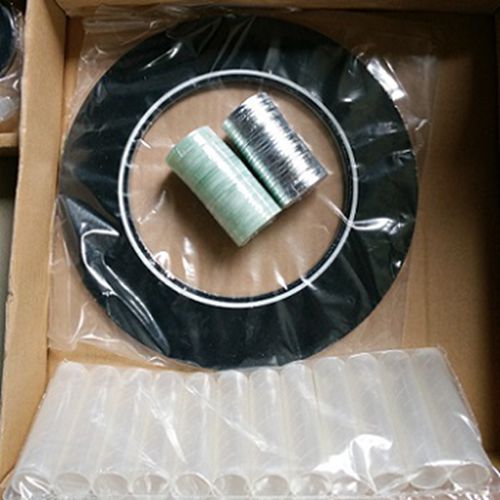
Each KXT 1002 kit includes the neoprene faced phenolic central gasket (Type E geometry), insulating sleeves, insulating washers and steel back-up washers. Kaxite operates an ISO 9001 quality system; kits are supplied with material certificates and dimensional inspection records. Dielectric strength is verified on the central gasket before shipment. Third-party inspection (SGS, BV, Intertek) can be coordinated. For the full range of isolation kit types, see flange insulation gasket kits.
Standard MOQ is 10 sets; standard lead time is 7–15 days for standard Type E neoprene faced kits — a common bulk order size for MRO and pipeline contractors. Kaxite is a China supplier of KXT 1002 neoprene faced phenolic kits, with ISO 9001 production in Ningbo. Custom sizes and OEM packaging are quoted separately with confirmed timing. State the flange size, pressure class and service temperature at inquiry so the neoprene temperature limit can be checked against the actual duty.
Send your flange size, pressure class and service temperature. Engineering team confirms the neoprene temperature margin and kit configuration before quotation.
Request KXT 1002 Quotation