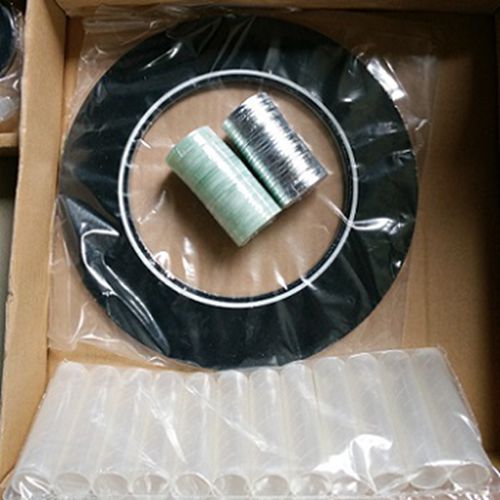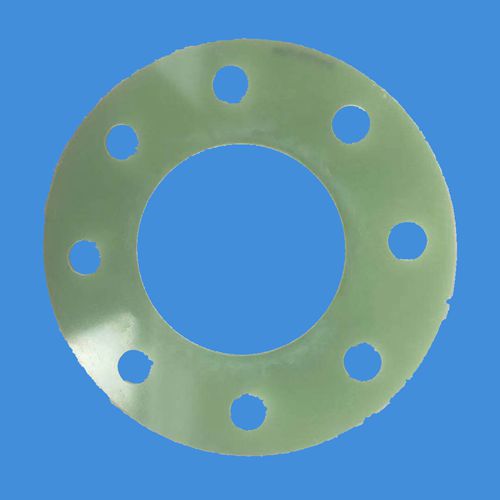


Most insulation gaskets are cut with bolt holes. Type F is not. The central gasket is an annular ring with no bolt holes at all. The outside diameter is machined slightly smaller than the inside diameter of the bolt circle. When the flange closes, the gasket self-centers inside the bolt circle — no manual alignment, no bolt-hole lineup, no risk of a sleeve catching on a misaligned gasket edge. That is the Drop-in logic. It is a different geometry, not a cost-reduced Type E.
| Dimension | Type F (this page) | Type E | Type D |
|---|---|---|---|
| Flange facing | Raised-face (RF) | Full-face (FF) | RTJ ring groove |
| Bolt holes in central gasket | None | Precision-cut | None |
| Centering mechanism | OD slightly less than bolt circle ID — automatic | Bolt holes sleeve onto bolts | Wedges into groove; groove walls constrain |
| Installation character | Drop-in; no manual centering | Bolt holes must align with bolts | Requires alignment pins and careful seating |
| Typical failure risk | Insufficient tape wrap — external bridging | Bolt-hole contamination or sleeve misalignment | Missing alignment pin or tape wrap |
On a Type E kit, if the bolt holes are slightly misaligned during assembly, the insulating sleeve can catch on the gasket edge and leave a sliver of phenolic exposed — a potential conductive path. Type F removes that failure mode by removing the bolt holes entirely. The gasket positions itself from the outside diameter, and the insulating sleeves only have to isolate the bolts from the flange holes. Fewer alignment interfaces, fewer ways for the kit to short out. For full-face flanges where bolt holes are required, see Type E flange insulation gasket kits.
| Carrier | Dielectric (V/mil) | Compressive (psi) | Max Temp (°C) | Best For | Avoid When |
|---|---|---|---|---|---|
| Plain Phenolic (default) | 500 | 25,000 | +104 | Standard RF flanges, cost-sensitive projects, sealing priority | Service above 104°C |
| Neo-faced Phenolic | 500 | 25,000 | +79 | Rough raised face requiring a soft sealing layer | Service above 79°C |
| G-10 Epoxy Glass | 550 | 50,000 | +138 | Higher temperature, higher bolt load, lower water absorption | Cost-sensitive standard service |
| G-11 Epoxy Glass | 550 | 50,000+ | +176 | Higher temperature ceiling | Cost-sensitive standard service |
The trade-off is temperature and cost. Plain phenolic gives −54°C to +104°C and the lowest material cost. G10 doubles the compressive strength and raises the temperature ceiling to +138°C, at a higher price. For a soft sealing face on a rough raised surface, the neoprene faced phenolic option drops the upper limit to +79°C. For RTJ flanges where the gasket must seat inside a groove, see Type D RTJ insulation kits.
| Dielectric strength | 500 V/mil |
|---|---|
| Compressive strength | 25,000 psi |
| Water absorption | 1.6% |
| Insulation resistance | 40,000 Meg Ohms |
| Flexural strength | 22,500 psi |
| Operating temperature | −54°C to +104°C (−65°F to +220°F) |
| Standard thickness | 1/8″ (3.2 mm) |
| Pressure class | ANSI Class 300 standard; confirm for higher ratings |
Type F has no bolt holes, but the raised face is still exposed at the flange OD. Conductive debris — rust scale, water, graphite dust — can bridge that exposed edge. Wrap the assembled flange OD with insulation tape after bolting. This step is specified for a reason; field failures on Type F kits are almost always contamination bridging, not the phenolic itself.
Drop-in removes the manual bolt-hole alignment step. It does not remove the need for clean flange faces, correct bolt load and tape wrap. The kit is easier to install, not maintenance-free.
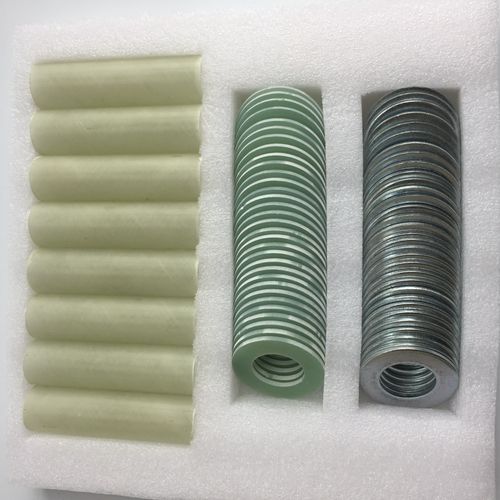
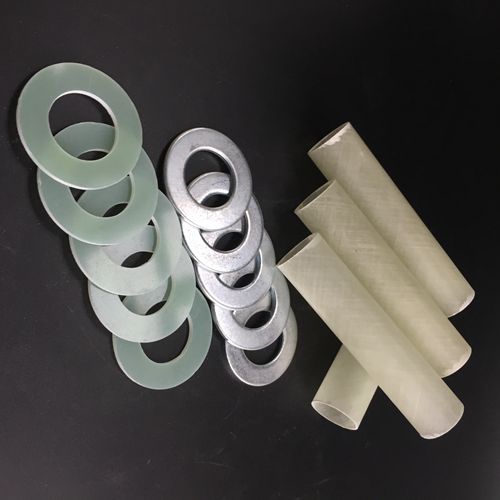
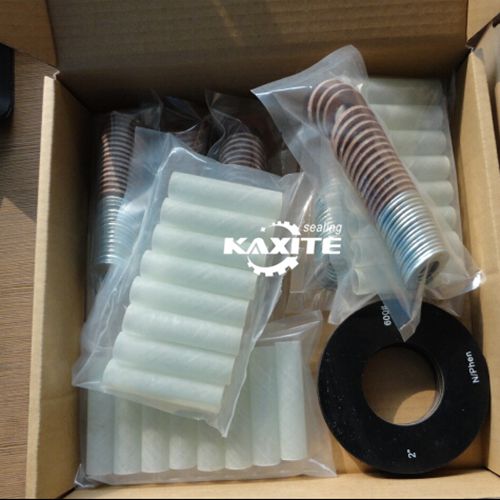
Each Type F kit includes the annular phenolic central gasket, insulating sleeves, insulating washers and steel back-up washers. Kaxite operates an ISO 9001 quality system; kits are supplied with material certificates and dimensional inspection records. Dielectric strength is verified on the central gasket before shipment. Third-party inspection (SGS, BV, Intertek) can be coordinated. For the full range of insulation kit types, see flange insulation gasket kits.
Standard MOQ is 10 sets; standard lead time is 7–15 days for standard RF kits. Custom carrier materials (G10/G11) and non-standard sizes are quoted separately with confirmed timing. OEM marking and private-label packaging are available. For very critical service beyond the standard phenolic range, see the VCS flange insulation gasket kit.
Send your RF flange size, pressure class, carrier material (phenolic / G10 / G11) and service temperature. Engineering team confirms the kit construction, MOQ and lead time.
Request Type F Kit Quotation