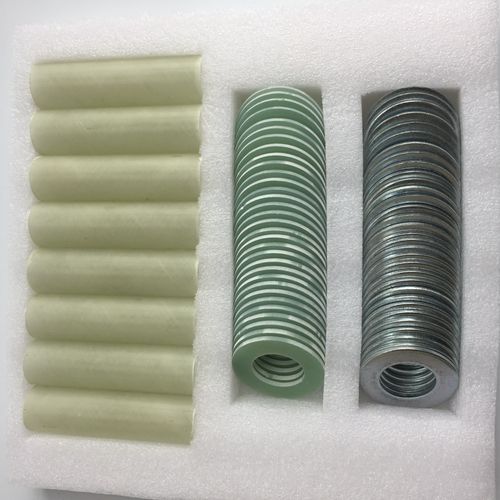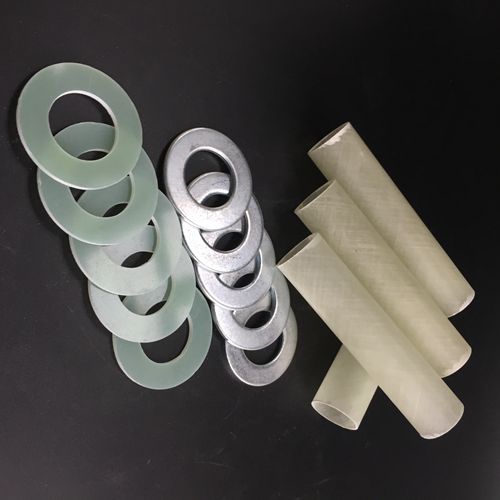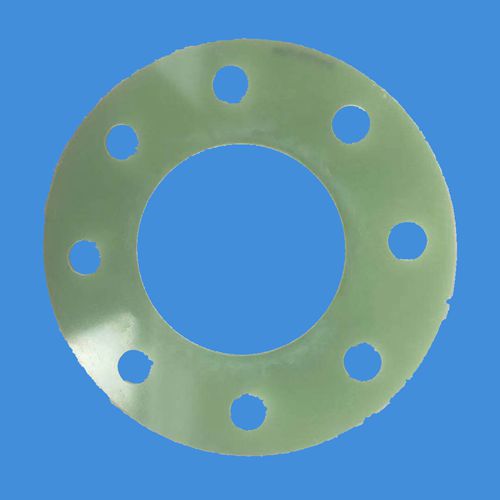


A ring-type-joint flange does not have a flat sealing face. It has a machined groove. The gasket does not sit on the flange — it sits inside the groove. Type D is the only insulation kit type that matches this geometry. The central gasket is machined to the groove profile, not cut from flat sheet. Octagonal is standard because the angled faces wedge into the groove; oval is available for specific RTJ standards. A flat Type E or Type F gasket cannot substitute for Type D on an RTJ flange.
| Dimension | Type D (this page) | Type E | Type F |
|---|---|---|---|
| Flange facing | RTJ ring groove | Full-face (FF) | Raised-face (RF) |
| Central gasket geometry | Octagonal (standard) / oval (special) | Full-face with bolt holes | Annular, no bolt holes |
| Sealing mechanism | Wedges into groove; constrained by groove walls | Covers entire flange face | Sits only on raised face |
| OD logic | Matched to RTJ groove | Same as flange OD | Slightly less than bolt circle ID |
| Typical pressure ceiling (phenolic) | ANSI Class 300 | ANSI Class 300 | ANSI Class 300 |
Octagonal is the default because the angled faces develop a wedge effect against the groove walls under bolt load. Oval Type D rings are used where the RTJ groove itself is oval or where the applicable standard specifies an oval profile. The choice is not a preference — it is dictated by the flange standard and the groove geometry. State the RTJ standard (ASME B16.5, API 6A, BX) at inquiry so the correct profile is quoted. For the full range of insulation kit types, see flange insulation gasket kits.
Use pins in two diametrically opposite bolt holes. Pin diameter must be a minimum of 3/32″ (2.38 mm) larger than the bolt size. This keeps the gasket centered in the groove while the flange is brought together.
Wrap the outside of the flange assembly after bolting. The exposed edges of the RTJ groove are a short-circuit path for conductive debris. Tape closes that path. Field failures on Type D are almost always alignment or contamination, not the phenolic itself.
| Dielectric strength | 500 V/mil (ASTM D149) |
|---|---|
| Compressive strength | 25,000 psi |
| Water absorption | 1.6% |
| Insulation resistance | 40,000 Meg Ohms |
| Flexural strength | 22,500 psi |
| Operating temperature | −54°C to +104°C (−65°F to +220°F) |
| Neo-faced option | Upper limit drops to +79°C if a neoprene sealing face is specified |
| Standard pressure class | ANSI Class 300 |
| Higher-pressure option | API / BX configurations available up to 15,000 psi |
For full-face flanges, see Type E flange insulation gasket kits. For raised-face flanges, see Type F flange insulation gasket kits. For a soft-faced phenolic option outside the RTJ geometry, see neoprene faced phenolic gasket kit.
The standard Type D phenolic kit is an ANSI Class 300 product. Class 900/1500 RTJ service requires a higher-grade carrier or an API/BX configuration — the plain phenolic ring alone is not rated for those pressures. Plain phenolic covers −54°C to +104°C; a neoprene sealing face drops the upper limit to +79°C. For high-temperature RTJ isolation, G-10 or G-11 carriers are the appropriate direction. If the service combines maximum temperature and maximum pressure, do not specify both at the ceiling simultaneously; confirm the actual operating envelope at inquiry. For very critical service beyond the standard phenolic range, see the VCS flange insulation gasket kit.
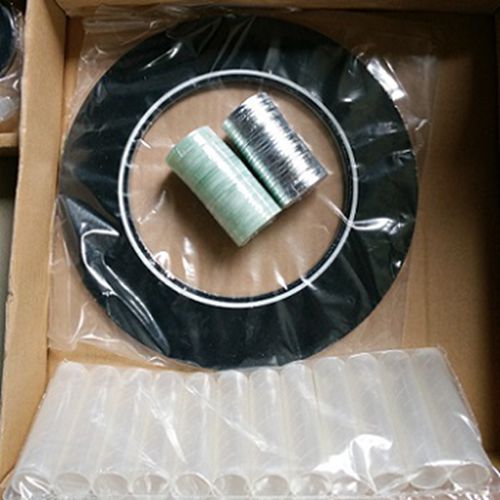
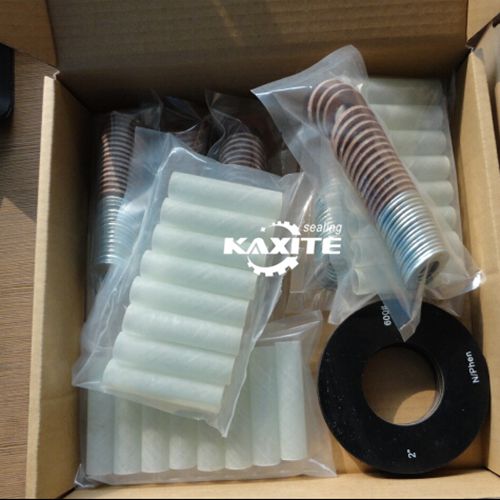
Each Type D kit includes the octagonal or oval phenolic central gasket, insulating sleeves for every bolt/stud, insulating washers and steel back-up washers. Kaxite operates an ISO 9001 quality system; kits are supplied with material certificates and dimensional inspection records. The phenolic carrier is verified for dielectric strength before shipment. Third-party inspection (SGS, BV, Intertek) can be coordinated.
Standard MOQ is 10 sets; standard lead time is 7–15 days for standard RTJ kits. Custom shapes and non-standard pressure classes are quoted separately with confirmed timing (typically 15–20 days). OEM marking and private-label packaging are available. State the RTJ flange size, pressure class, gasket shape and service temperature at inquiry.
Send your RTJ flange size, pressure class, gasket shape (octagonal or oval) and service temperature. Engineering team confirms the kit construction, MOQ and lead time.
Request Type D Kit Quotation