
A phenolic RTJ insulation kit is a solid ring of laminated phenolic sitting in the ring groove of an RTJ flange. It seals by bolt stress: the bolts compress the phenolic ring until it conforms to the groove. In low-pressure, dry service that works. In high-pressure acid gas service — CO₂, H₂S, produced water — it does not. The phenolic ring cracks under load, relaxes under thermal cycling, and leaks. The failure mode is not occasional; it is repeatable, and it was the reason VCS was developed in the first place[reference:17]. VCS does not make a better phenolic ring. It replaces the solid-ring architecture with a metal-core, pressure-activated seal.
Bolt load compresses a solid phenolic ring into the groove. High pressure and thermal cycling can crack or relax the ring.
A PTFE spring-energized seal sits in a machined groove through the G-10 laminate into the 316SS core. Line pressure loads the seal from behind.
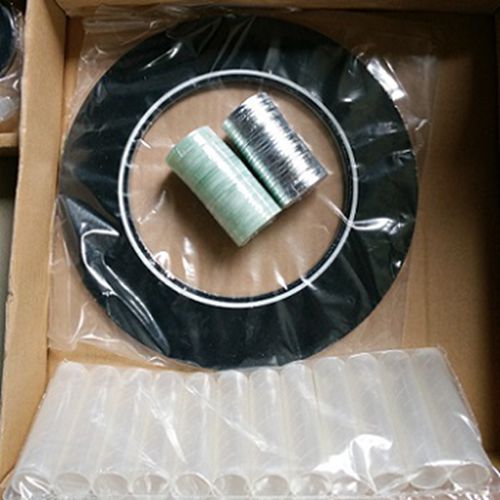
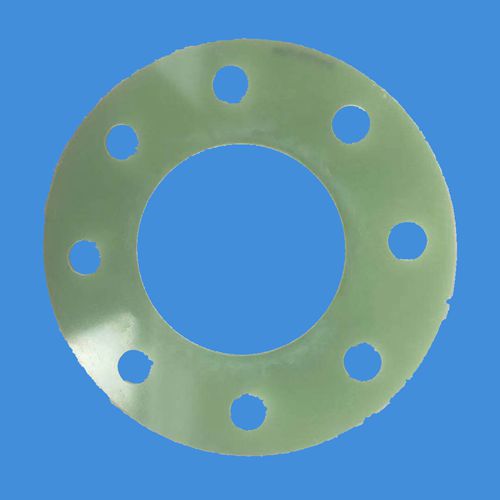
VCS is a three-layer construction: a 316 stainless steel core, G-10 glass-reinforced epoxy laminate bonded to both faces, and a PTFE spring-energized seal seated in a dovetail groove machined through the laminate and into the metal core[reference:18]. The seal does not rely on bolt stress to compress a solid ring. It relies on line pressure entering the seal cavity and loading the PTFE element from behind. The higher the pressure, the tighter the seal. That is why VCS covers ANSI 2500# and API 15,000 psi — the seal is energized by the very pressure that would cause a solid phenolic ring to fail[reference:19]. The G-10 laminate provides the dielectric barrier (550 V/mil, 65,000 psi compressive in VCS configuration), and the metal core provides the structural base that a glass laminate alone cannot[reference:20].
| Dimension | VCS (this page) | Phenolic RTJ kit |
|---|---|---|
| Seal activation | Pressure-activated; line pressure loads the seal | Bolt-stress-activated; bolts compress a solid ring |
| Pressure coverage | ANSI 2500# / API 15,000 psi | Practical limit around ANSI 300 for solid phenolic |
| Acid gas (CO₂ / H₂S) | Designed for fluid-trap corrosion elimination in RTJ flanges | Phenolic can degrade or crack; not the correct architecture |
| Mismatched RTJ ↔ RF | Seals both; can mate mismatched flanges | RTJ groove only; cannot seal on RF |
| Bolt stress required | Far lower — seal is not dependent on bolt load to start sealing | High — bolt stress must compress the solid ring |
| Seal replacement | PTFE element replaceable in reusable retainer | Gasket is single-use |
For standard-pressure full-face or raised-face isolation where phenolic is sufficient, the Type E full-face kit and Type F raised-face kit are the lower-cost choices. VCS is specified when the cost of gasket failure cannot be tolerated.
| Metal core | 316 stainless steel (standard); 316L, Inconel 625/825, SMO 254, AL6XN, Duplex/Super Duplex optional |
|---|---|
| Insulating carrier | G-10 glass-reinforced epoxy laminate (standard); G11, G10CR optional |
| G-10 compressive strength | 65,000 psi |
| G-10 dielectric strength | 550 V/mil |
| G-10 water absorption | 0.005% |
| G-10 continuous temperature | −128°C to +150°C (−200°F to +320°F) |
| Seal material | PTFE spring-energized (standard); elastomeric O-ring (Viton, etc.) optional |
| Pressure coverage | ANSI 2500# / API 15,000 psi |
| Flange compatibility | RF, FF, RTJ; mismatched RTJ-to-RF |
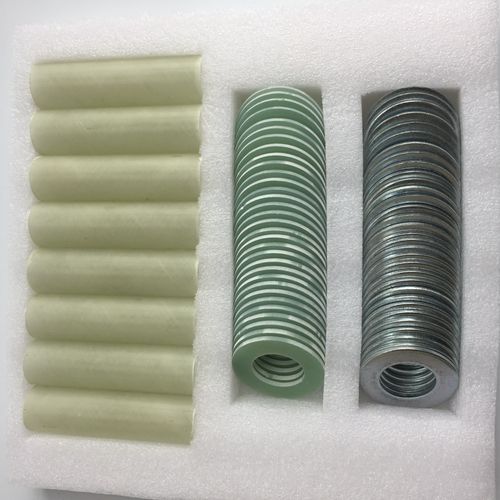
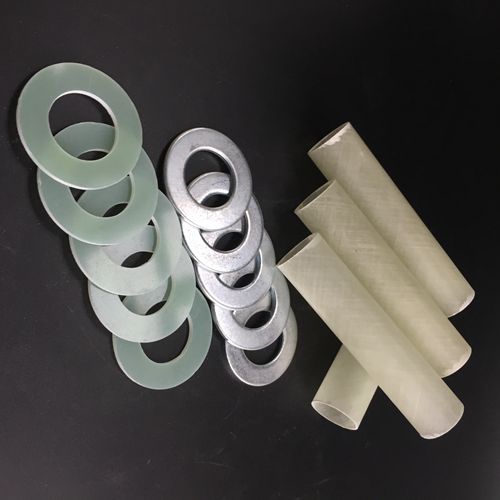
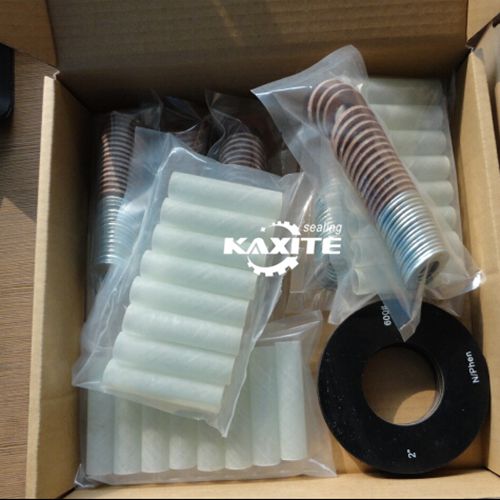
| Kit contents | Central gasket; G-10 sleeves (1/32″); G-10 washers (1/8″) with zinc-plated steel back-up washers |
| Seal replaceability | PTFE seal elements replaceable in reusable retainer |
For the matching G10 sleeve and washer as standalone components, see G10 insulation sleeves and G-10 glass epoxy washer. For the full flange insulation kit family, see flange insulation gasket kits.
1. Pressure exceeds the practical limit of solid phenolic. If the flange is ANSI 900, 1500 or 2500, or API 10,000 / 15,000 psi, a phenolic ring is not the correct architecture. VCS is.
2. The service is acid gas with fluid-trap corrosion risk. High CO₂, H₂S and produced water in RTJ flanges create a corrosion cell in the ring groove. VCS eliminates the fluid trap and is designed to withstand those media[reference:21][reference:22].
3. The flange facings do not match. When an RTJ flange must be isolated against a raised-face flange, VCS seals both because the sealing element sits in the core, not in the groove. This is a common field problem in wellhead tie-ins and flowline retrofits.
For cathodic protection isolation on standard pressure classes, the flange insulation gasket kit range covers the full selection. For high-temperature VCS variants (G-11 carrier), state the temperature at inquiry.
MOQ: 10 kits for standard configurations. Standard lead time: 7–15 days; custom sizes quoted separately with confirmed timing. FOB Ningbo / EXW / CIF available. To quote VCS correctly, specify: flange standard, nominal size, pressure class, facing type (RF/FF/RTJ, and whether the facings are mismatched), service medium and temperature, and seal material (PTFE standard or elastomeric O-ring). VCS is configured to the joint — not selected from a catalog part number.
Send your flange standard, size, pressure class, facing type (including mismatched RTJ/RF), service medium and temperature. Engineering team confirms the VCS seal/carrier configuration and returns quotation with lead time.
Request VCS Kit QuotationThe VCS is not a phenolic kit with a higher pressure rating. It is a different sealing architecture: a 316 stainless steel core bonded to G-10 insulating laminate, with a PTFE spring-energized face seal seated in the core. The seal is pressure-activated — it uses the line pressure itself to load the PTFE element, so it seals at far lower bolt stress than a solid phenolic gasket. That is why the VCS covers API 15,000 psi and ANSI 2500# service, seals mismatched RTJ-to-RF flanges, and survives H2S/CO2 fluid-trap corrosion where standard RTJ phenolic kits fail. G-10 carrier: 65,000 psi compressive, 750–800 VPM dielectric, 150°C continuous. ISO 9001; MOQ 10 sets, 7–15 day lead time.