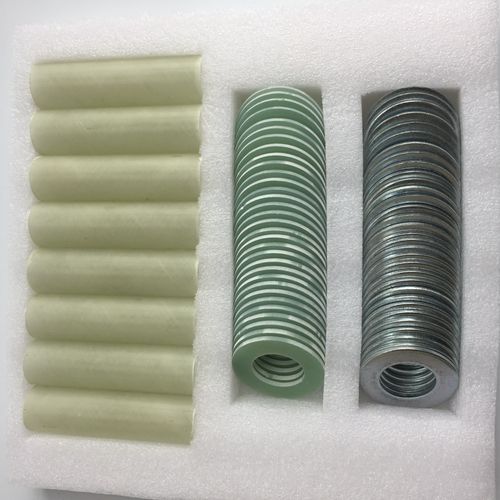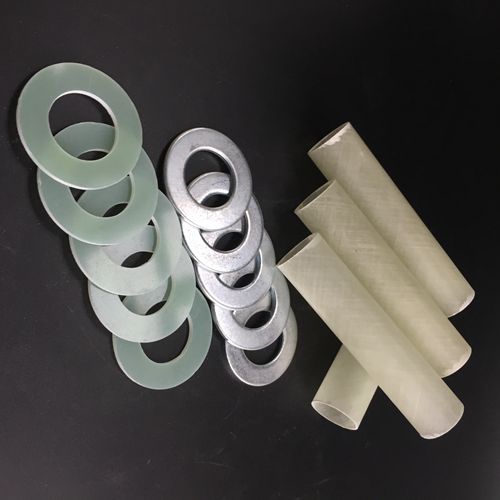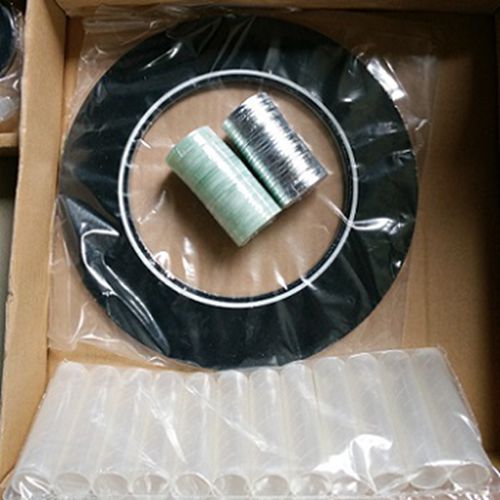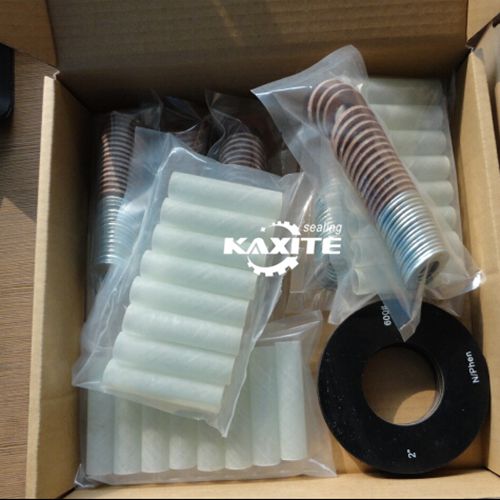

A flange insulation gasket kit is not a thicker gasket. It is a four-component dielectric system: the central gasket isolates the two flange faces, the sleeves isolate each stud bolt from the flange bolt hole, the washers isolate the nuts and bolt heads from the flange faces, and the steel back-up washers distribute bolt load without crushing the insulating washers. If any component is missing or the wrong material, the cathodic protection current finds a path through the bolting, and the isolation is lost. The kit is a system — selecting it means selecting all four components, not just the gasket.
| Kit Type | Flange Facing | Key Geometry | Best For | Avoid When |
|---|---|---|---|---|
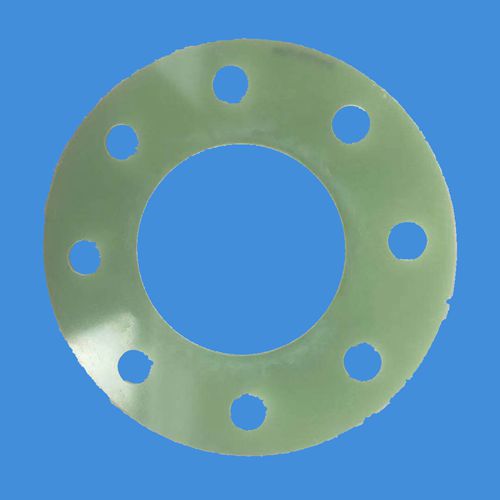
| Type E | Full-face (FF) | Same OD as flange; precision-cut bolt holes; covers entire face | Standard FF isolation; external debris bridging risk | Raised-face or RTJ flange |
| Type F | Raised-face (RF) | No bolt holes; OD slightly less than bolt circle; self-centering | RF flanges; Drop-in installation | Full-face or RTJ flange |
| Type D | Ring type joint (RTJ) | Octagonal or oval ring; seats inside the ring groove | RTJ flanges; high-pressure ring joint service | FF or RF flange |
| Type O (option) | FF or RF body | O-ring sealing element on each face; constant contact | Sour service or where additional sealing is required | Standard dry service where O-ring is unnecessary |
The flange face determines the type. Type E is the default for full-face flanges; Type F for raised-face without bolt holes; Type D for RTJ grooves. Type O is a sealing enhancement available on Type E or Type F bodies, not a separate flange geometry. For a deep technical comparison of each type, see the Type E full-face kit page and the Type F raised-face kit page.
| Material | Dielectric Strength | Continuous Temperature | Best For | Avoid When |
|---|---|---|---|---|
| G10 Glass Epoxy | 800 V/mil | −196°C to +150°C | High bolt load, humid/wet service, cathodic protection, long life | Cost-sensitive dry service where phenolic is sufficient |
| G11 Glass Epoxy | 550 V/mil (grade dependent) | −196°C to +200°C | Higher temperature than G10 | Standard temperature, cost-sensitive |
| Phenolic | 500 V/mil | −54°C to +104°C | Standard pressure, dry service, cost-sensitive kits | Wet/humid service, high bolt load, cathodic protection |
| Neoprene Faced Phenolic | 500 V/mil | −54°C to +79°C | Rough or imperfect flange surfaces; soft sealing face | Service above 79°C |
| PTFE | Grade dependent | −200°C to +260°C | Chemical and corrosive service; wide temperature range | High bolt load where creep is a concern |
G10 is the default for cathodic protection and pipeline isolation because it holds dielectric strength and wall thickness under bolt load and moisture. Phenolic is the cost-down option for dry, moderate-duty service. Neoprene faced phenolic adds a soft sealing face for rough flanges but lowers the temperature ceiling. PTFE is specified for chemical compatibility, not for structural bolt load. For the matching G10 washer, see G-10 glass epoxy washer; for the matching sleeve, see G10 insulation sleeves.
| Parameter | Standard Range |
|---|---|
| Pressure class | ASME 150# to 2500# (PN420); VCS grade up to API 15,000 psi |
| Size | 1/2″ (DN15) to 60″ (DN1500); larger on request; custom up to DN2000 |
| Flange standards | ASME B16.5, B16.47, API 6A, DIN, JIS, BS, MSS SP44 |
| Industry standards | NACE SP0286, NACE SP0206; NACE MR0175 / ISO 15156 for sour service |
| Material standard | ASTM D709 / NEMA LI-1 G-10 for glass epoxy grades |
The kit is sized to the flange pair — not selected from a stock list. State the flange standard, size, pressure class and facing type at inquiry. For high-pressure acid gas or mismatched RTJ-to-RF service where a standard phenolic kit is not sufficient, see the VCS very critical service kit.
Flange insulation kits are specified wherever a bolted flange joint must carry fluid but must not carry current. The primary applications are cathodic protection isolation on buried or subsea-to-above-ground pipeline transitions, galvanic corrosion isolation between dissimilar metals (carbon steel to stainless, copper-nickel to steel), and stray current control at metering stations, compressor stations and refinery unit boundaries. The kit breaks the metal-to-metal path without interrupting the pressure boundary. For soft-face isolation on imperfect flanges, see the neoprene faced phenolic kit.
MOQ: 10 kits for standard configurations. Standard lead time: 7–15 days. Custom sizes and OEM packaging: quoted separately with confirmed timing. FOB Ningbo / EXW / CIF available. To quote correctly, specify: flange standard, nominal size, pressure class, facing type (FF/RF/RTJ), gasket material or service medium, temperature, and whether a Type O O-ring is required. A kit is configured to the flange and service — the more precisely the specification is stated, the faster the quotation. For custom sizes beyond 60″, confirm at inquiry before assuming availability.
Send your flange standard, size, pressure class, facing type (FF/RF/RTJ) and service medium. Engineering team confirms the kit type, material grade and lead time.
Request Kit QuotationType E is the full-face kit. The central gasket has the same outside diameter as the flange and precision-cut bolt holes — it covers the entire flange face, not just the raised portion. Bolt holes locate the gasket on the bolts; the full-face coverage prevents external conductive debris from bridging the flange OD. Plain phenolic carrier: 500 V/mil dielectric strength, 25,000 psi compressive strength, 40,000 MΩ insulation resistance, −54°C to +104°C. Standard thickness 1/8″. ANSI Class 300; G10/G11 available for higher temperature. ISO 9001; MOQ 10 sets, 7–15 day lead time for standard kits.

Type F is the raised-face Drop-in kit. There are no bolt holes in the central gasket — the outside diameter is slightly smaller than the bolt circle inside diameter, so the gasket centers itself inside the bolt circle as the flange closes. That geometry removes a handling step and eliminates the risk of a bolt-hole misalignment that would leave a conductive path. Plain phenolic carrier: 500 V/mil dielectric strength, 25,000 psi compressive strength, 40,000 MΩ insulation resistance, −54°C to +104°C. Standard thickness 1/8″. ANSI Class 300; G10/G11 available for higher temperature. ISO 9001; MOQ 10 sets, 7–15 day lead time for standard kits.

Type D is the RTJ-specific member of the flange insulation kit family. The central gasket is a medium-weave fabric-reinforced phenolic ring, machined to the octagonal (standard) or oval (on request) profile that seats inside the ring groove of a ring-type-joint flange. Plain phenolic carrier: dielectric strength 500 V/mil, compressive strength 25,000 psi, insulation resistance 40,000 Meg Ohms, service −54°C to +104°C. The kit ships with insulating sleeves, insulating washers and steel back-up washers. ANSI Class 300 standard; API/BX configurations available for higher pressure. ISO 9001; MOQ 10 sets, 7–15 day lead time for standard kits.